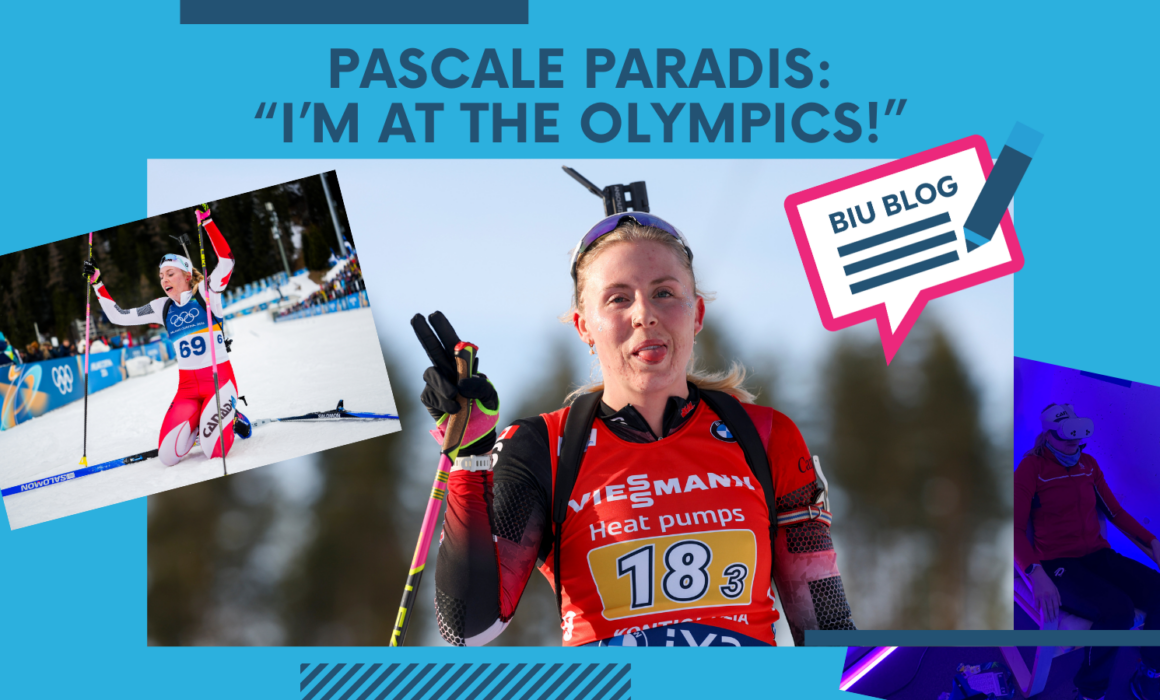
I’m at the Olympics!
Canada’s Pascale Paradis, one of the BIU’s Integrity Ambassadors, reflects on her experiences at Milano-Cortina 2026, her first Olympic Games.
The BIU spoke to Pascale at her base at Kontiolahti, Finland, the first IBU World Cup event after the Olympic Games in Milano-Cortina, where the biathlon events were held at the Antholz-Anterselva Biathlon Arena near Italy’s border with Austria.
“It was my first Olympics and it felt very surreal for a long time,” she recalls. “It just felt like, because we had raced there before, and it was the same set-up, staying in a hotel with a couple of other teams, and them being similar teams to those we usually stay with, it felt a little bit similar, but different at the same time: more pressure.
“But it honestly was so nice that the village felt so familiar. It allowed me to not get too wrapped up in the, ‘Oh my God, I’m at the Olympics!’”
Antholz-Anterselva is a venue with a long-standing tradition in the sport, having hosted numerous international events, including IBU World Cup stages and six IBU World Championships, and therefore familiar to many of the athletes.
By contrast, says Pascale, “I visited Cortina one day, and there were so many other people there, and a lot more going on. So I think it was really cool to see that, but it already felt overwhelming, so I can’t imagine what it would be like with hundreds of other athletes from different sports”.
Social media
So how did Pascale cope with the ‘overwhelming-ness’ she refers to?
“I definitely had to make more of an effort to have ‘me-time’,” she says. “It was hard to keep my routine the same. And it was really hard for me not to get too wrapped up in social media, because it’s a great opportunity for that, but also really easy to get too wrapped up in it and miss out on the experience because you’re so busy looking at other people’s social media and trying to keep up with your social media.”
However, Pascale says, she did take advantage of a recent dispensation that allows athletes to post their own video footage from the Games. This was important because it enabled her to demonstrate the popularity of the sport to her Canadian followers. “A lot of people had no idea that biathlon’s actually a popular sport in Europe,” she says. “In the start pen, it’s the stands and the noise. There’s people from other sports in Canada, saying: ‘You guys have that many people there?’ It’s bringing awareness to the Canadian Olympic Committee that biathlon’s quite big here and really popular.”
Support
For Pascale, the biggest difference between the Games and a regular IBU World Cup event was the support from back home in Canada. This was evident among the spectators at her four races, but also in social media and other messaging.
She says: “A lot of people don’t follow biathlon in Canada, but my family came and some of their friends came, and everyone watches the Olympics, and biathlon’s a fun sport to watch, so people were reaching out saying, ‘This is so crazy and cool!’ Even people from high school.
“So that was the biggest difference – the importance of it. Because it felt more important, I felt like I really wanted to make them proud. So it felt like a good kind of pressure for me because I perform well under pressure – if it’s not too much pressure! There’s a fine balance, in biathlon for sure, in performing under stress. If there’s no stress at all, then it’s hard to perform, but if there’s stress, then it’s easy to get locked up and get ‘in your head’ a lot.”
Pressure
That pressure came through the media as well, says Pascale, adding: “We never do CBC [the Canadian public-service broadcaster] interviews, for example, after a [World Cup] race, so that was new. Actually having people wanting to talk to you after a race: it was cool to experience!”
Pascale says she was happy with a career-best result in her 15km individual race, in which she finished 24th out of 90 competitors. She says she went into the race with relatively low expectations after a difficult year, focusing on “trying to process it all and doing my thing, and I think that was super-helpful for me. I think I did the best I could. We had a really good pre-camp and I was feeling good. Nothing’s ever perfect, but looking back on it I can’t think of anything I would have done differently.”
She chose to go home for Christmas ahead of the Games, even though it was not recommended by her coaches because of the 25-hour journey. “But for me”, she says, “a reset at Christmas time is very worth it for the duration of the season, because it’s just such a long season.”
Mind Zone
After its introduction at the Paris 2024 Olympics, the Athlete365 x Powerade Mind Zone was in place at all Olympic Villages of the Milano-Cortina Games, including Antholz-Anterselva, with the aim of supporting athletes at the Games.
Pascale highly recommends it, saying: “It’s a really nice break, because the Games are such high stimulus for two weeks straight, all day, every day, and it’s a nice, quiet space, for sure.”
The idea behind the Mind Zone is to provide a quiet, welcoming space where athletes can relax, recharge, and mentally reset in the middle of intense competition schedules. In venues that are often loud, busy, and emotionally charged, the space offered something rare: calm. In Antholz-Anterselva, the Mind Zone was staffed by BIU officials.
Pascale adds: “There were dim lights, and it was very serene, and there was a corner blocked off for some privacy with a virtual reality headset, and it took me through some breathing exercises. At first I thought, ‘I’m not going to get into this, but then, after a few minutes, it’s quite calming, because your brain is totally surrounded, and it totally takes you to another environment.”
Relaxing
Outside the Mind Zone, Pascale took baths, knitted and read her book to relax. “My favourite thing is, I make a coffee in the morning and then I read my book,” she says. “Really focusing on that was important because it was hard for me to put social media away.” This approach she describes as “intentionally setting some time aside for nothing.”
One lesson Pascale says she took away from the Games was to allow herself to enjoy her positive performances and not to dwell on the negative ones (she performed less well than she had hoped in the mixed and women’s relays and sprint 7.5km competition). “Enjoy how it feels,” she says, “because with biathlon you never know. It’s so up and down and it takes time to build consistency.
Finally, Pascale’s advice to other athletes who are targeting their first Olympics is: “Just take it in. Realise that it’s a very special experience and very few people get to experience it. It’s a life-long thing, so really embrace that. It’s not all going to be fun. There are some downs. The negative races are even harder to cope with. So enjoy the good moments when they’re there. There are going to be some harder times – but that’s okay.”