I’m at the Olympics! Pt 2
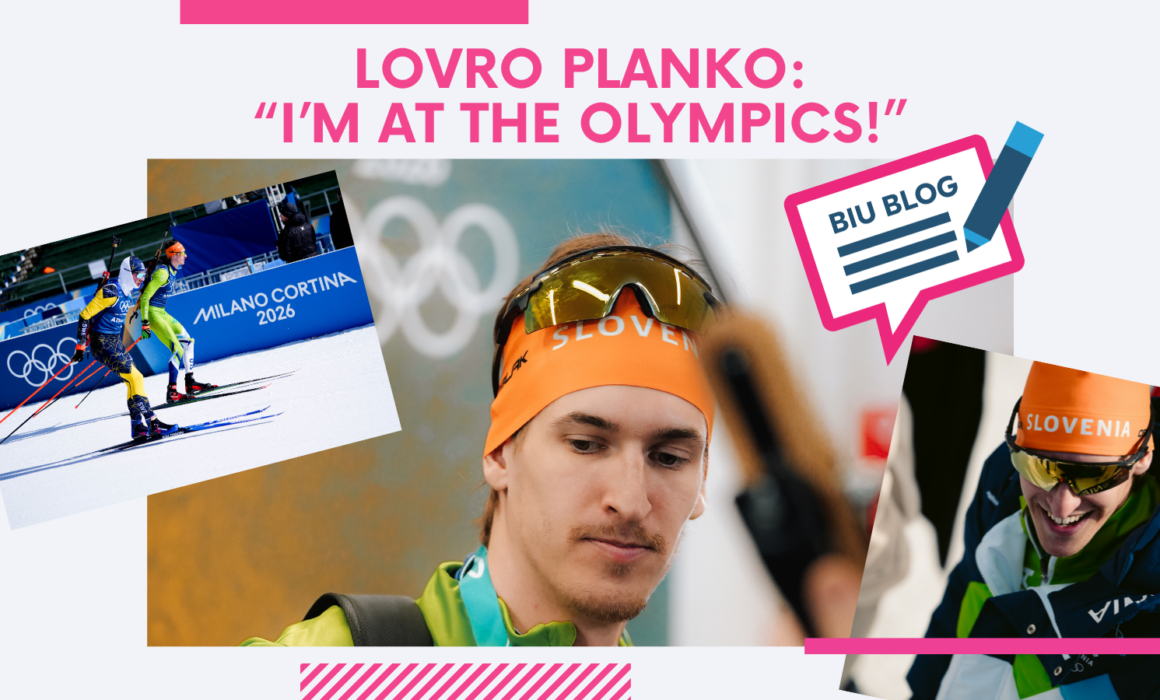
In the second of our two-part series on competing at the Olympic Games, Slovenia’s Lovro Planko, a BIU Integrity Ambassador, reflects on his experiences of Milano-Cortina 2026.
The Milano-Cortina Games were Lovro’s second experience of competing at an Olympics, after participating in the previous edition in Beijing. Asked to compare the two editions, Lovro cites first the obvious difference that the Beijing Games took place during the Covid pandemic, meaning that athletes competed in front of largely empty stadia.
At the Antholz-Anterselva Biathlon Arena, venue for the 2026 biathlon events, Lovro continues, “there was a bit of nervousness in the air, compared to a normal World Cup. But I think the main difference was that it was happening in Italy – it’s much more home-like. It’s much more similar to Slovenia, compared to China, where nothing was similar to Slovenia! And definitely the temperature was a big difference because at the last Olympics the temperatures were around minus 20.”
And did he actually enjoy the Games?
“Very much,” he says. “I think the Olympic Games are the dream of every athlete. I was competing for the second time and I enjoyed it just as much as I did in China, if not even more, because everything was a bit more relaxed.”
Expanding on the nervousness he mentioned earlier, Lovro says: “You know it only happens once every four years, so you know it means a bit more [than a regular World Cup event]. So you want to do well. But I think that people that didn’t treat it as something different maybe did the best.”
Lovro says that he worked with his mental coach to try to combat his nerves, adding: “I knew that I was well-prepared, so that’s the most important thing. You need to be confident in what you’re doing. But also in the back of your head you’re always aware that this only happens every four years, that it’s the Olympic Games. I think I dealt with it pretty well. I was pretty nervous at the first race, but once it started it was good. I knew that I trained well, I knew that I did this many times.”
Tips Lovro received from his mental coach included keeping in mind that “if you do a bad race, it doesn’t mean you’re a bad athlete. I always say that the race is just the last 20 minutes of the training you did so far. So, if you did well for the last 700 hours, then the last 20 minutes won’t burn everything. That’s a thing I keep telling myself.
“I wasn’t happy with my performances, but I’m looking forward to the next [Games]. I think I’m going to use the Olympic performances as a fuel for my motivation. I’m really looking forward to getting back to training, so I can come back stronger in four years.”
In the course of the Games, Lovro visited the Athlete365 x Powerade Mind Zone, introduced recently at the Olympic Games with the specific purpose of helping athletes to prepare themselves mentally for the challenges posed by competing in such a high-profile event.
He says he sent some postcards home from the venue, adding: “That was a really nice touch they had there. You could send some postcards for free and stay in touch with your family, or send them something, like a little souvenir from the Olympic Games. I think if you panicked a little, if you got a bit too hyped, you could just go there and calm your mind a little. I think the Mind Zone was a nice addition to the venue. If you need a place to calm down, to be alone with your thoughts for a bit, that’s the place to go.”
The more recent, decentralised model of the Olympic Games, in which athletes from different countries and sports no longer stay together in the same Olympic Village and compete in a single cluster of venues means that they miss out to some extent on the traditional ‘Olympic spirit’, Lovro says. But he also says, “I get it that the countries can’t build everything in one place. This is definitely more nature-friendly and sustainable, to decentralise everything.”
Lovro says that he continued his usual use of social media during the Games, adding: “I think it’s a time when you can grow your personal brand because the whole world is watching. I got a blue tick on Instagram, which is a nice addition! But I was there to compete, not to make Tik Toks and Instagram reels.”
As for the risk of receiving negative feedback, Lovro says: “I learned long ago that I should not read the anonymous comments on different blogs and web pages. Because at first it can seem funny, but if you’re not in a really good place and if you had bad races, that can only make things worse. So I think it’s better just to stay away, just don’t open it, because the couch commentators don’t always know the whole story.”
For Lovro, the highlight of the Games was seeing his family among the spectators for the first time (they were unable to attend the Beijing Games because of the pandemic). He says: “I think they were all super-proud seeing me compete at the Olympics. It was a big goal, not just for me, but for the whole family. I still get a bit emotional when I think of that. So definitely a highlight!”
Asked what he did to relax during the Games, Lovro says with a laugh: “I read some books. I read a lot of Harry Potter! Also, we had a pretty nice hotel. We had a pool. So I was hanging out with my teammates.”
Finally, Lovro’s advice to other biathletes approaching their first Olympics is: “If you trained well, if you’re confident in your training, then sooner or later that will show up in a race. It’s a long way to the Olympic Games, but it’s super-worth it. So, stay with it.”